The essay · Issue 01
Two Artists. Two Centuries. One Wall.
On a German Orientalist of the 1890s and a Russian realist of 2017, both at work before the same stones in Jerusalem.
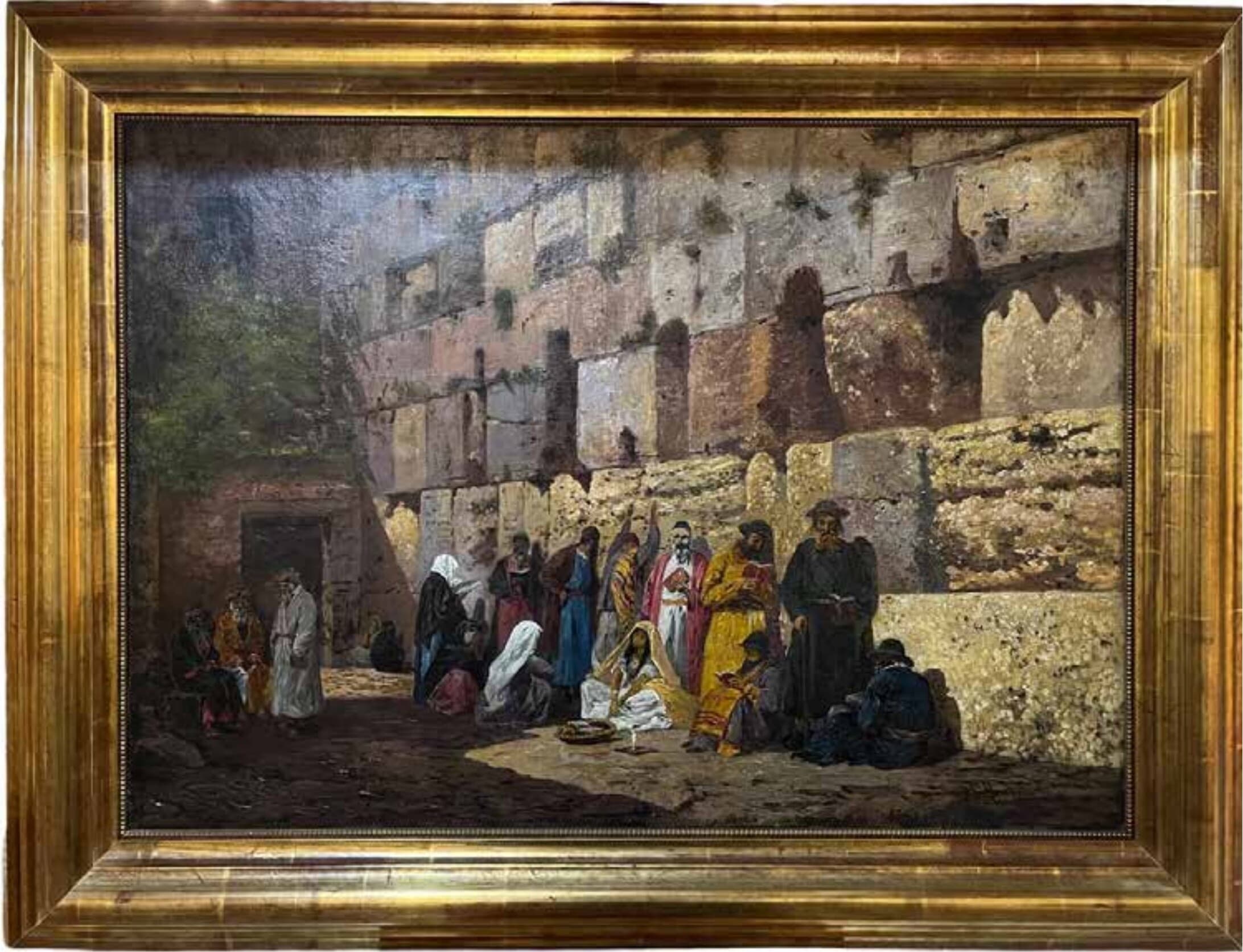
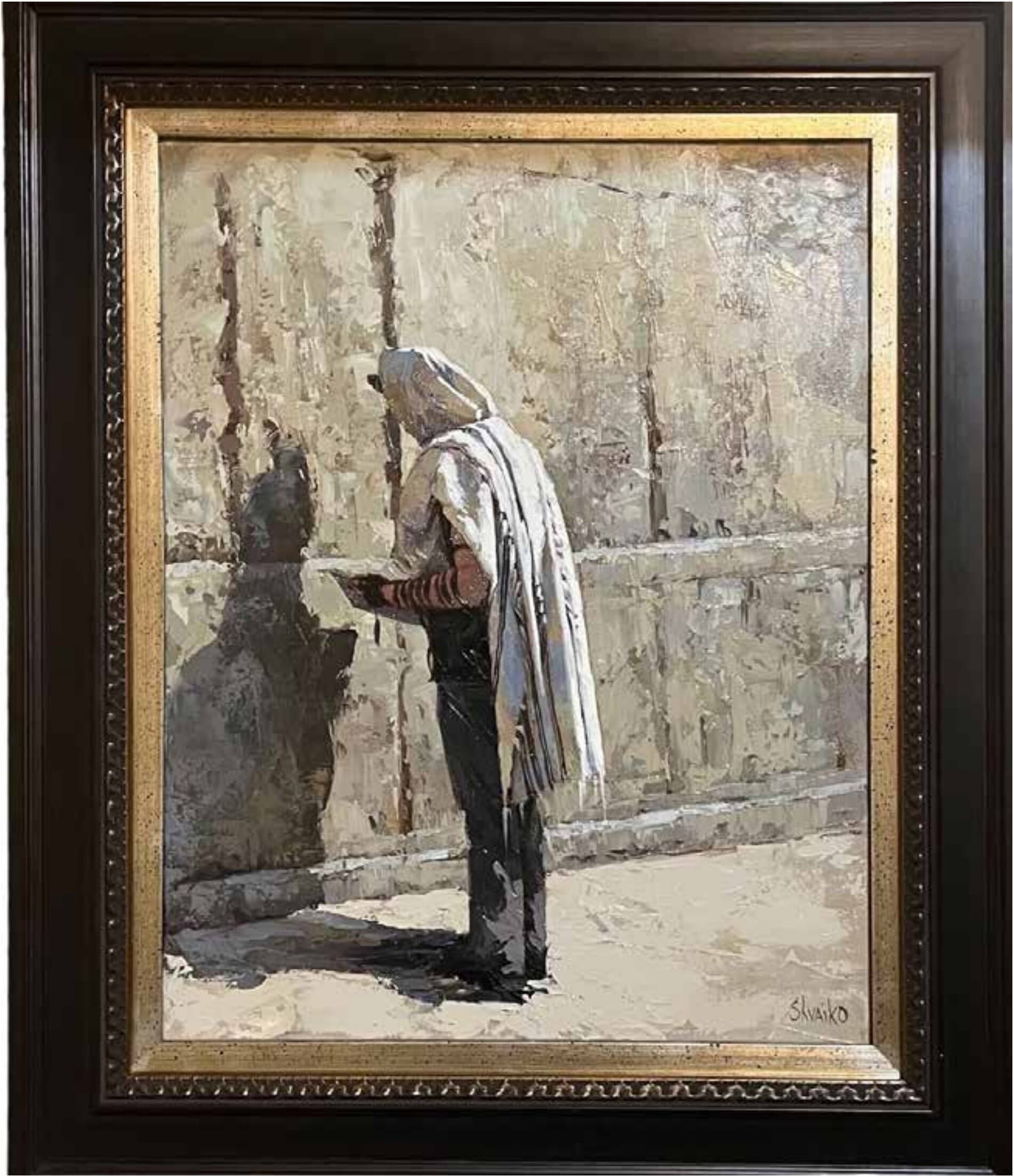
The Western Wall in Jerusalem — the surviving western retaining wall of the Herodian Temple Mount platform, built in the late first century BCE — is one of the most painted, photographed, and inhabited surfaces on earth. Friedrich Perlberg approached it in the 1890s. Viktor Shvaiko approached it in 2017. The interval between their canvases is roughly a hundred and twenty-five years; the wall, in the photographs that bracket each painting, has barely changed.
Perlberg, born in Nuremberg in 1848 and trained in Munich, belongs to the late nineteenth-century European tradition of artists who travelled to the eastern Mediterranean and worked from direct observation. His Klagemauer Der Juden — German for 'Wailing Wall of the Jews' — measures 31 by 45 inches, is painted in oil on canvas, and is dated to the period 1890 to 1895, which corresponds to his Holy Land travels of that decade. The composition is panoramic and documentary in character: the wall takes up the full width of the canvas; the worshippers are individuated rather than typological; the light is the dry, level light of late afternoon Jerusalem.
"Where Perlberg's canvas reads as a record, Shvaiko's reads as a meditation."
Shvaiko, born in 1965 and trained in the Russian academic realist tradition, approaches the same wall on a vertical canvas, 20 by 16 inches, oil on canvas, signed within the image and dated 2017. The view is closer, quieter, and more devotional. The Herodian ashlar is warmed by glazing; the figures are fewer; the temperature is interior. Where Perlberg's canvas reads as a record, Shvaiko's reads as a meditation.
Read together, the two paintings frame a long European argument with the same subject: the documentary nineteenth century giving way to a more intimate twenty-first-century devotional realism. They also frame the work of the network itself, which presents paintings that span exactly this kind of arc.
Reference
Frequently asked.
- Who was Friedrich Perlberg?
- Friedrich Perlberg (1848–1921) was a German Orientalist painter, born in Nuremberg and trained at the Royal Academy in Munich. He travelled in the eastern Mediterranean during the 1890s and is known for paintings and watercolours of Jerusalem, the Sinai, and Egypt.
- Who is Viktor Shvaiko?
- Viktor Shvaiko, born in 1965, is a contemporary Russian realist painter. He is internationally known for academically trained oil paintings of European cityscapes and sacred sites, executed with layered impasto and warm light.
- What is the Wailing Wall?
- The Wailing Wall — also called the Western Wall, in Hebrew Ha-Kotel ha-Ma'aravi, in German Klagemauer — is the surviving western retaining wall of the Temple Mount platform in Jerusalem, built under Herod the Great in the late first century BCE. It is the principal site of Jewish prayer in the Old City.
- How does Viktor Shvaiko's Wailing Wall compare to 19th-century treatments?
- Where the late nineteenth-century European Orientalist tradition produced panoramic, documentary canvases of the Western Wall — Friedrich Perlberg's Klagemauer Der Juden of 1890–1895 is a typical example — the contemporary Russian realist treatment by Viktor Shvaiko, painted in 2017, narrows the view: a vertical canvas, a smaller scale, fewer figures, warmer interior light, and a more devotional rather than documentary register. The two paintings show how the same subject is reframed across roughly a hundred and twenty-five years of European painting.